
Colorado's New EV Charger Registration:
7 CCR 1101-19
Understanding Colorado’s New EV Charger (EVSE) Registration Requirements.
Colorado’s Division of Oil & Public Safety recently introduced a new registration requirement, 7 CCR 1101-19, for all publicly accessible retail (pay-to-charge) AC and DC electric vehicle (EV) charging stations.
Effective July 1, 2026, the regulation requires Colorado station owners to register covered charging equipment with the state through a Registered Service Agency (RSA).
The intent of this new regulation is to create greater consistency in how EV chargers measure and sell electricity, giving drivers and station operators a clearer, more predictable charging experience.
NCC is here to help make the process easier to understand and navigate. We’ve provided a wealth of resources below.



Colorado’s New Requirements, Made Easier.
New regulations can create new questions. Our job is to make yours easier.
Over the last 14 years, National Car Charging has helped organizations across Colorado plan, deploy, operate and maintain reliable EV charging infrastructure. Today, we are actively working through the certification process, collaborating with the state and our manufacturers, and digging into the details of 7 CCR 1101-19.
Our goal is simple: help you, the charging station owners, understand what is required, evaluate existing equipment and build a practical path toward compliance.
To help you get up to speed quickly, we have outlined the key information in the FAQs below. And because the regulation and certification process are still new, we will continue to update this page as additional guidance and implementation details become available.
Have Retail EV Charging Station(s) in Colorado?
If you own or operate one or more retail (pay-to-charge) charging stations that need to be registered, complete our quick form to get started.
Need More Answers About 7 CCR 1101-19?
Start with the FAQs below, but if you still have questions, please call or email us. We are happy to share what we know, explain what is still evolving and help you determine the right next steps for your charging stations.

FAQs.
What Charging Station Owners Need to Know About Colorado’s New EVSE Registration.
-
Colorado now regulates publicly accessible, retail (pay-to-charge) EV stations in a way that is similar to how it regulates gas pumps and retail scales. The regulation includes requirements for registration, accuracy certification, pricing transparency and periodic inspection.
-
The regulation applies to owners and operators of publicly accessible EV charging stations in Colorado where drivers pay for the electricity they receive.
-
Description text goes hereThe regulation does not apply to:
EV chargers owned or operated by a public utility
Charging stations that provide free charging
Behind-the-fence chargers used exclusively by private or public fleets
Home chargers at private residences where no retail transaction takes place
-
Register each charger with the state. This includes information such as the location, model, serial number, power specifications and network provider.
Have the charger’s meter tested and certified for accuracy.
Label the equipment clearly. Required information may include voltage, amperage, AC or DC designation, serial number, certification number and owner contact information.
Display pricing clearly at the point of sale. This includes the price per kWh, energy delivered, applicable fees and total transaction cost.
-
Yes. Chargers installed after July 1, 2026, are considered new installations and must meet the requirements on an accelerated timeline.
Chargers already in service before July 1, 2026, must be registered by January 1, 2027.
-
Before installation: The equipment must have an active NTEP accuracy certificate.
At installation: Required labeling and point-of-sale pricing information must be in place.
Within 30 days of going live: The station owner must register the charger with the Division.
Within 90 days of going live: A Registered Service Agency must submit a placed-in-service report confirming the meter’s accuracy.
-
By January 1, 2027: Register the charger with the Division.
By July 1, 2027: Meet the applicable labeling requirements and certification requirements.
By July 1, 2030: Hold an NTEP or California-equivalent CTEP accuracy certificate, meet point-of-sale pricing requirements and have a Registered Service Agency’s placed-in-service report on file.
What happens if I miss a deadline or my charger fails inspection?
Beginning July 1, 2027, a state inspector may physically seal a noncompliant charger and take it out of service until the issue is corrected and a Registered Service Agency confirms that it can return to operation.
Legacy chargers that do not meet the EVSE certification deadline may also be taken out of service.
-
Ultimately, registration is the station owner’s responsibility. It generally involves submitting site and equipment information directly to the state.
A Registered Service Agency (RSA) will provide the testing and documentation needed for compliance, but it cannot complete the registration on the owner’s behalf.
The state does not require installers or RSAs to hold manufacturer certifications. However, many manufacturers, including ChargePoint, Kempower and Tritium, require installers and service providers to be properly trained or certified to protect the equipment warranty.
-
The regulation notes that local authorities, including fire departments and building officials, may have their own requirements.
This does not create a new state-level permitting obligation, but separate local permits or approvals may still be required. It is always a good idea to check with your city or county.
-
Colorado does not currently charge registration, device or state inspection fees.
Registered Service Agencies are independent businesses and may charge for the professional services they provide. The RSA services specifically required by the state include the placed-in-service report and the five-year accuracy inspection.
NCC and our sister company, Alliance Electric Solutions, understand that these are new and likely unplanned expenses. Both companies are committed to keeping these services as affordable and straightforward as possible.
-
A Registered Service Agency, or RSA, is a company or individual authorized by the state to test and verify that an EV charger’s meter is measuring electricity accurately.
An RSA is needed to complete the EVSE placed-in-service report and to perform periodic accuracy testing at least once every five years.
-
The Registered Service Agency (RSA) certification process was only recently released, and both NCC and Alliance Electric Solutions are actively working through it.
Customer service has always been central to how we operate, and both companies intend to become certified as quickly as possible so we can support all of our current and future Colorado customers through this process.
We are also committed to keeping the cost of these services reasonable.
-
Yes. The company that installs the charger may also serve as the RSA and submit the placed-in-service report for the same project.
The state reviews and audits submitted reports. A company may lose its RSA status if its reports contain deficiencies, inaccuracies or discrepancies.
-
DC fast chargers receive additional time to meet the accuracy-testing requirement. That requirement is deferred until January 1, 2028.
The deferral applies only to accuracy testing. Registration, labeling and point-of-sale pricing requirements still follow the standard timelines.
-
Yes. Every retail, pay-to-charge station must be tested and sealed for accuracy at least once every five years.
Additional testing may also be required whenever a component is replaced or software is updated in a way that could affect measurement accuracy.
Routine repairs that do not affect how the charger measures or delivers electricity, such as replacing a screen shield or cord-management component, generally do not require additional filing. Repairs involving the meter, charging head or other accuracy-related components will require retesting and a new placed-in-service report.
-
Testing follows an established NIST procedure.
In practice, this may involve connecting an electric vehicle through calibrated testing equipment—sometimes referred to as a “man-in-the-middle” test setup—to confirm that the charger is accurately measuring and reporting the electricity delivered.
-
An RSA’s metrological testing equipment must have a traceable certificate of accuracy.
That equipment must also be recertified by an accredited metrology laboratory every two years, or according to the manufacturer’s recommended schedule. A current certificate must remain on file with the state.
-
Any identified deficiency must be corrected before the charger can return to service and documentation confirming the correction must then be submitted to the Colorado Division of Oil and Public Safety.
-
Does my charger’s registration expire?No. Registration remains valid as long as the same device, with the same serial number, remains in service at the same location.
If a repair or software change could affect the charger’s measurement accuracy, an RSA may need to submit a new placed-in-service report. Routine repairs that do not affect accuracy generally do not require additional action.
-
Yes. The advertised price must be shown in whole cents per kWh—for example, $0.35 rather than $0.359—and it must match the price actually charged by the station.
-
Confirm whether your chargers are considered retail stations or qualify for an exemption.
Check whether your equipment already holds NTEP certification.
Contact NCC, Alliance Electric Solutions or complete our registration form to discuss your stations.
Mark the applicable registration, labeling, testing and certification deadlines on your calendar.
-
We’ve got you covered. Below are links and downloads for all the official published information.
Retail Electric Vehicle Charging Program (Colorado Division of Oil & Public Safety)
Forms — Retail EV Charging Program (registration, placed-in-service forms)
OPS Regulations & Statutes (official rule text, 7 CCR 1101-19)
Code of Colorado Regulations — Division of Oil & Public Safety rule listing
Download the State’s Official FAQs.
These requirements are new for everyone, and we know they are likely to raise a lot of questions. That is why we created this plain-language FAQ to help EV charging station owners, operators and partners understand what may be required and when.
Here you will find straightforward answers to your EV charger registration questions, accuracy testing, labeling and pricing transparency, along with links to official state resources.
PLEASE NOTE: NCC’s FAQs are an overview intended to make 7 CCR 1101-19 easier to understand. It reflects our current interpretation of the regulation and is not legal advice. Because every site is different and guidance may continue to evolve, we encourage all station owners and operators to confirm any site-specific compliance questions with the Colorado Division of Oil and Public Safety or qualified legal counsel. Ultimately, charging station owners are responsible for ensuring their equipment and sites meet all applicable requirements.
Certified Expertise & Strong Manufacturer Partnerships.
NCC holds leading manufacturer certifications and works closely with the industry’s top EV charging brands.
These partnerships give our team deeper product knowledge, direct access to manufacturer resources and the training needed to recommend, install and support the right charging solution for every site.



Compliance Is Step One. Reliability Is the Long Game.
Meeting Colorado’s new EVSE requirements is step one. Keeping your charging stations reliable, operational and ready for drivers is the next.
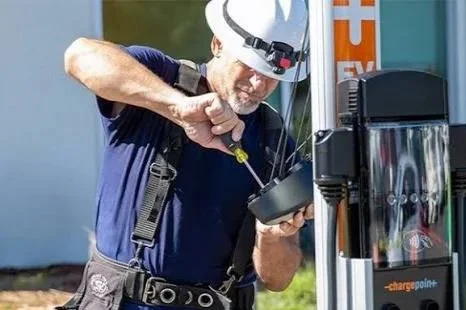
National Car Charging’s C3™ service program brings preventive maintenance, responsive repairs and our unique dedicated Service Concierge support together in one coordinated solution. From routine inspections and warranty coordination to troubleshooting and repair, our team helps reduce downtime, extend equipment life and take the day-to-day stress out of managing your charging network.
Protect your investment. Improve reliability. Keep your stations charging.

NCC is Colorado-Based. Nationally Recognized. Proven in the Field.
National Car Charging is proudly a Colorado-based EV charging infrastructure leader with more than 14 years of experience helping organizations plan, deploy and support reliable charging infrastructure nationwide.
Proven Partnerships. Recognized Performance.
2026 Colorado Company to Watch Winner!
A Platinum ChargePoint reseller and certified installer for over a decade
The nation’s leading Kempower reseller and certified installer
These distinctions represent more than sales. They reflect NCC’s deep product expertise, proven installation experience and commitment to matching every site with the right EV charging solution.
From strategic planning and equipment selection to installation, preventive maintenance, repairs and ongoing support, NCC brings the experience, partnerships and accountability to move your EV charging program forward with confidence.

Ready to get registered or need service?
Whether you need help with registration, preventive maintenance, repairs or ongoing support, NCC is ready to help you take the next step.